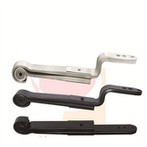
In the design, manufacture, assembly, adjustment and use of the front axle of a car, care must be taken to prevent possible shimmy of the steering wheel. It refers to the phenomenon that the steering wheel is constantly swinging around the kingpin when the car is running. It will damage the normal driving of the car. The shimmy vibration of the front steering wheel has two types: self-excited vibration and forced vibration. The former is due to the influence of the hysteresis characteristics in the lateral deformation of the front axle tires, so that the force of the road surface acting on the tires in a vibration cycle of the system does positive work on the system, that is, the external energy inputs energy to the system. If the value of the latter is greater than the energy consumed by the damping in the system, the system will increase and vibrate until the energy reaches a dynamic equilibrium state. At this time, the system will continue to vibrate at a certain amplitude, forming a shimmy.
Its vibration frequency is approximately close to the natural frequency of the system and is not consistent with the wheel speed of the front axle, and it occurs in a wide range of vehicle speeds. The shimmy that usually occurs at low speeds is often of the self-photographic vibration type. When the steering wheel and the steering system are stimulated by periodic disturbances, such as wheel imbalance, end face bounce, unevenness of the geometric and mechanical properties of the tire, and kinematic interference, the rotation of the wheel will constitute a periodic disturbance. Under the periodic continuous action of the disturbance force, forced vibration will occur. Resonance occurs when the excitation frequency of the disturbance is consistent with the natural frequency of the system. Its characteristic is that the shimmy frequency of the steering wheel of the front axle assembly is the same as the wheel speed, and generally there is an obvious resonance speed with a narrow resonance range (3~5km/h). The shimmy that usually occurs at high speeds is often of the forced vibration type.
The causes and influencing factors of front axle steering wheel shimmy are complex, including structural design and manufacturing factors. Such as wheel imbalance, the mechanical characteristics of the tire, the stiffness and damping of the front and rear axle systems, the positioning angle of the steering wheel, and the strength of the gyro effect; there are also influences on assembly adjustments, such as the gap between the various links of the front axle steering system (influence The stiffness of the system) and the coefficient of friction (affecting damping), etc. Reasonable selection of the relevant parameters of the front and rear axles of the car, optimization of the matching between the front and rear axles, and careful manufacturing and assembly adjustments can effectively control the occurrence of front wheel shimmy. In the design of the front axle of the automobile, increasing the stiffness of the steering gear assembly and the steering rod system and the longitudinal stiffness of the suspension, increasing the lateral stiffness of the tires, and installing a lateral shock absorber in the steering rod system to increase damping, etc., are all to control the car Some effective measures for front axle wheel shimmy.